Three decisions, and then it is arithmetic
Almost every argument a flatshare has in month seven is about one of these three never having been said out loud in month one.
- What counts as shared. Rent and the metered bills are obvious. The disagreement is over the things one person uses more — the parking space, the second router, the cleaner who mostly cleans the kitchen.
- In what proportion. Equal is the right default and the right answer for anything metered. Rent is the exception, because rooms are not the same. A weight anybody can point at — floor area, or who got the balcony — survives an argument that a number somebody merely felt was fair does not.
- Who fronts the money. One person’s account pays the landlord. That person is not "the one who pays the rent": they are owed the rest of it back every month, and the amount they are owed is not the rent.
A worked month
Three flatmates. The rent is €1,800 and the rooms are not the same size, so it goes 40 / 35 / 25 by floor area — agreed when they moved in, which is the only time that conversation is easy. The internet is €50 flat. The electricity was budgeted at €120 a month and this month’s bill came to €141.60.
| Amount | Split | Alex | Bea | Chris | |
|---|---|---|---|---|---|
| Rent | 1,800.00 | by room, 40 / 35 / 25 | 720.00 | 630.00 | 450.00 |
| Internet | 50.00 | equally | 16.67 | 16.67 | 16.66 |
| Electricity | 141.60 | equally | 47.20 | 47.20 | 47.20 |
| Total | 1,991.60 | 783.87 | 693.87 | 513.86 |
The internet line is why this page has a calculator on it. €50.00 does not divide by three. Two flatmates pay 16.67 and one pays 16.66, and which one is decided by a fixed rule rather than by whoever is holding the phone. Rounding all three to 16.67 collects €50.01; rounding all three down collects €49.99. Neither of those is the bill.
The mistake: recording the estimate instead of the bill
A flatshare that keeps records at all usually keeps them like this: a line that says *Electricity — €120, monthly*, set up once, in whichever app or spreadsheet they chose. Then the bill arrives at €141.60 in January, €96.20 in May and €173.40 in December, and the line still says €120.
Nothing looks wrong for months, which is the problem. What eventually breaks is the reconciliation: somebody compares the shared record with the actual bank account, the two are a few hundred euros apart, and there is no way to say which month the difference came from. The record was never wrong about the plan. It was never right about the money.
The plan and the payment are two different facts and both are worth keeping. €120 a month is genuinely useful — it is what needs to be in the account before the bill lands. €141.60 is what left it. Keep only the first and you cannot reconcile; keep only the second and you cannot warn anybody.
That is how Sharefold handles it today: a repeating payment carries the amount you expect, and marking it paid accepts the amount that was actually paid. The expected figure stays on the plan and is never rewritten by an actual, so one cold December does not quietly become the new normal — each month is answered on its own.
Split it here, with the app’s own arithmetic
Integer minor units, no floating point, and shares that sum to exactly the amount you typed. This is the code the app runs, ported to the page.
Split one amount between three people
Equal, by weight or by percentage, in whole minor units. Change the numbers — the leftover cent is placed by a rule, not dropped.
| Weight | Pays | ||
|---|---|---|---|
| €720.00 | |||
| €630.00 | |||
| €450.00 | |||
| Total | €1,800.00 |
The leftover minor units go one each to the people at the top of the list — the same rule the app uses, so the same bill split twice gives the same answer twice.
Integer minor units, no floating point, and shares that add up to exactly the amount — the same code the app runs.
How a flatshare is set up in Sharefold today
- Create a Space of type Home. A Space is one household: its members, its currency, its records.
- Add your flatmates by name. A name is enough to split a bill with — nobody needs an account, an e-mail address or an invitation before the records can start. An invitation later turns a name into a member who can sign in, and everything they were already part of is waiting for them.
- Record the rent as an expense: who paid it, who shares it, and how. The split can be equal, by percentage, or an exact amount for each person.
- For anything that repeats, set a rule with a day of the month. Sharefold turns it into a planned payment for the months ahead, so nothing arrives as a surprise.
- When the bill actually lands, mark the planned payment paid — and change the amount to the one on the bill if it differs. The plan keeps its own figure.
- The balances screen answers *who owes whom*, per person and per currency, and offers a prepared payment for each debt that is really there.
- When somebody pays, record the settlement. The money moves outside Sharefold — bank transfer, cash, whatever you already use.
Sharefold moves no money and this is not a limitation being apologised for. It is a record-keeping tool: a balance in it is a note the members of a Space wrote to each other, not a bill anybody issues or a debt anybody enforces.
If you keep a kitty instead
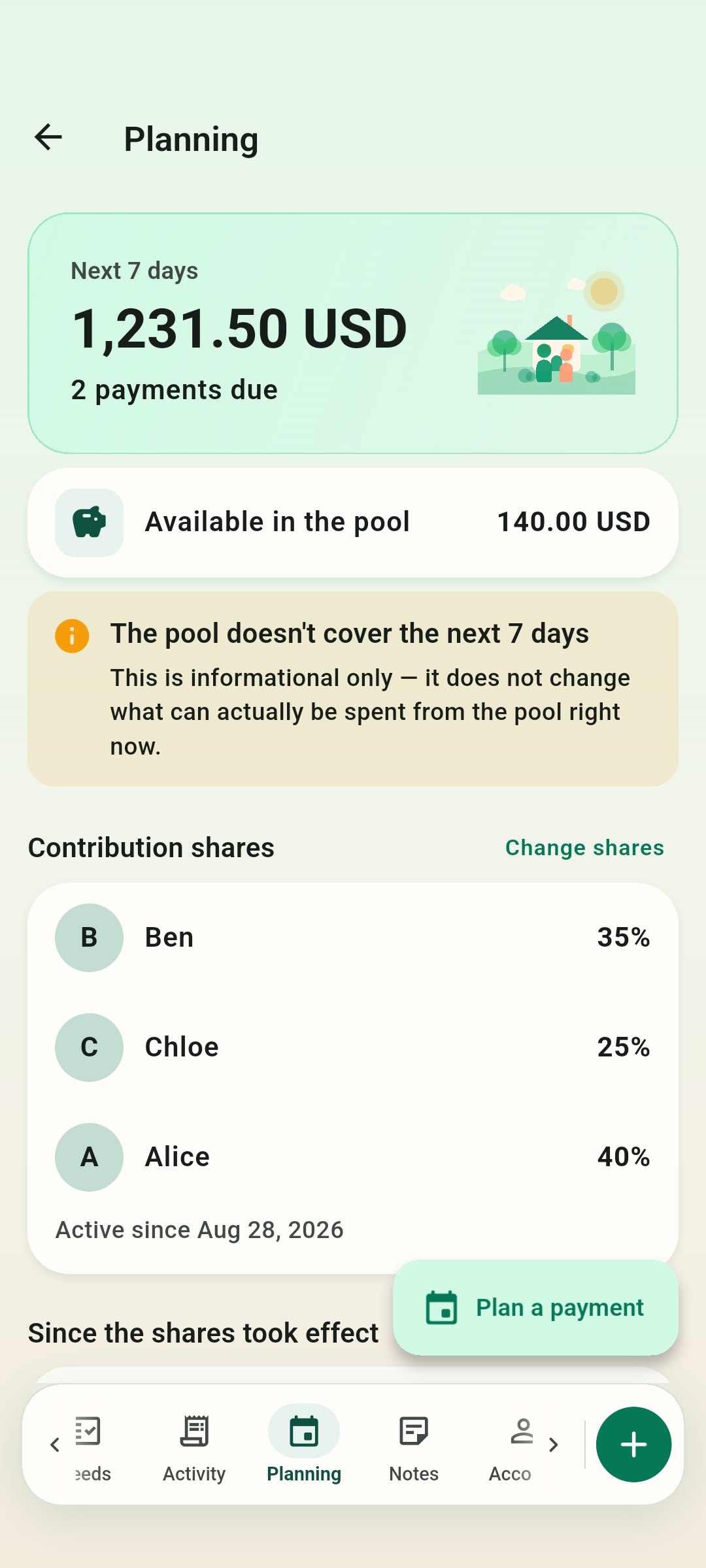
Some flatshares never settle up person to person. Everybody puts a fixed amount into one pot at the start of the month and the bills come out of it. Sharefold records that as a shared pool: what each person put in, what the group spent, and how much of what is left is still yours.
Unequal contributions survive the spending, which is the part a kitty in a shared bank account cannot do. If you put in more than your share and the pot empties, you are still owed the difference, and the app can still say by whom.
Also worth reading
- How to split a restaurant bill fairlyA worked example for a table of four: what dividing by the number of people really costs the person who ordered least, how a discount should come off, and a calculator that splits a bill item by item.
- Who owes what after a tripFour people, a week away and five payments to settle. A worked example, why one “who owes whom” number cannot span two currencies, and a calculator that settles the debts pair by pair.