Four people, one week
Alex books the flat. Bea hires the car. Chris pays for a dinner that Dee sat out because she was ill. Dee buys museum tickets for herself and Alex.
| Expense | Amount | Paid by | Shared by | Each |
|---|---|---|---|---|
| The flat | 840.00 | Alex | all four | 210.00 |
| Car hire | 320.00 | Bea | all four | 80.00 |
| Dinner | 190.00 | Chris | Alex, Bea, Chris | 63.34 / 63.33 / 63.33 |
| Museum tickets | 60.00 | Dee | Alex, Dee | 30.00 |
Which leaves everybody here:
| Paid | Their share | Net | |
|---|---|---|---|
| Alex | 840.00 | 383.34 | +456.66 |
| Bea | 320.00 | 353.33 | −33.33 |
| Chris | 190.00 | 353.33 | −163.33 |
| Dee | 60.00 | 320.00 | −260.00 |
And the debts, settled pair by pair, are five payments:
| Pays | To | Amount |
|---|---|---|
| Bea | Alex | 130.00 |
| Chris | Alex | 146.66 |
| Dee | Alex | 180.00 |
| Chris | Bea | 16.67 |
| Dee | Bea | 80.00 |
The mistake: one number for two currencies
The trip that goes wrong on the arithmetic is almost always the one that crossed a border. The flat was €840; the taxis, the dinners and the museum were ₺11,400; and somebody adds them together.
To add them you have to pick a rate. Picking one quietly makes somebody carry the gap between the rate on the day of the expense, the rate on the day you did the sum, and the rate their bank will actually give them — and nobody in the group agreed to take that on. There is no correct single rate, so there is no correct single number.
What there is, is two answers. *In euros, Bea owes Alex €130. In lira, Alex owes Chris ₺2,850.* Two settlements, each in the currency the money was spent in, and no one holding an exchange-rate position they never asked for.
This is what Sharefold does, and it is a refusal rather than an omission. A Space keeps a balance per currency and never sums them; a debt is paid in the currency it was incurred in, and nothing in the app converts one into the other. Record an expense in a currency that is not the Space’s own and the app offers the published reference rate for that day as an editable annotation — it names the day it came from rather than implying a live market price, and the expense saves perfectly well without it.
Why the list above is five payments and not three
Every app in this category has a button that makes the list shorter. Net each person’s position, match the biggest debtor to the biggest creditor and repeat: Alex is owed 456.66, so Dee pays 260.00, Chris pays 163.33 and Bea pays 33.33. Three transfers instead of five, and it closes perfectly.
It closes, and it is wrong about nearly everybody in it. Chris actually owes Bea 16.67 and the short list has Chris paying Alex instead — a payment to somebody he never borrowed from, while Bea, who is owed money on that pair, is billed. Sharefold tried this and removed it: every line the app suggests is a debt that is really there, netted only inside the pair that created it.
If your group would rather make three payments than five, do that — but do it as three people deciding out loud to take on each other’s debts, not because a screen presented it as the answer.
Settle your own trip
Add the expenses, say who paid and who shared, and the payments below are computed the way the app computes them: a debt per expense, netted only within a pair.
Settle a trip
One row per expense: what it was, who paid, and who shared it. Each expense creates a debt from each sharer to whoever paid, and the only netting is inside a pair.
| What | Amount | Paid by | Shared by | |
|---|---|---|---|---|
Where everyone stands
| Person | Paid | Share | Net |
|---|---|---|---|
| Alex | €840.00 | €383.34 | +€456.66 |
| Bea | €320.00 | €353.33 | €−33.33 |
| Chris | €190.00 | €353.33 | €−163.33 |
| Dee | €60.00 | €320.00 | €−260.00 |
Who pays whom
- Bea pays Alex€130.00
- Chris pays Alex€146.66
- Dee pays Alex€180.00
- Chris pays Bea€16.67
- Dee pays Bea€80.00
Integer minor units, no floating point, and shares that add up to exactly the amount — the same code the app runs.
Recording a trip in the app
- Create a Space of type Trip. Trip Spaces differ in two places that matter here: an expense can be entered in another currency, and the planning list offers what a trip actually plans — a flight, somewhere to stay, car hire, a tour, insurance.
- Add everyone by name. Nobody needs an account to appear in the records; an invitation link turns a name into a member who can sign in whenever they get around to it.
- Record each expense as it happens, with who paid and who shared. The payer is a field, not an assumption — the app never takes it that whoever typed the expense also paid for it.
- Somebody who sat out a dinner is simply unticked on that expense. Nothing else about the trip changes.
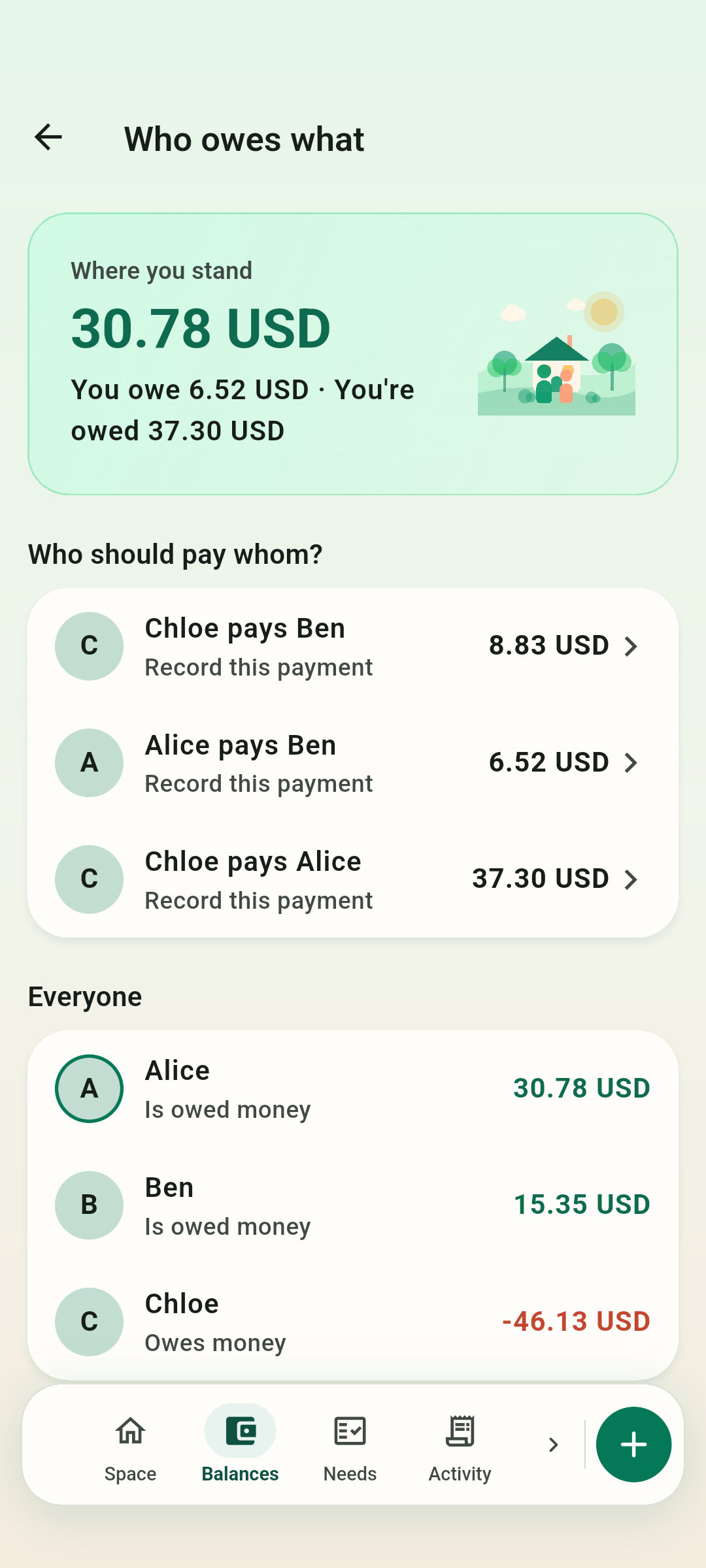
- Settle up lists who should pay whom, grouped by currency, with a payment prepared for each debt. Accepting one opens the ordinary settlement form with the pair and the amount already filled in.
- The summary card puts *who owes whom* into a form you can send straight into the group chat.
- The transfer itself happens outside Sharefold. The app records it; it does not carry it.
Also worth reading
- How to split rent and bills with flatmatesA worked month for three flatmates: rent split by room, a bill that will not divide by three, and the mistake that makes a flatshare’s records drift away from its bank statements.
- How to split a restaurant bill fairlyA worked example for a table of four: what dividing by the number of people really costs the person who ordered least, how a discount should come off, and a calculator that splits a bill item by item.